






The technique of the future - Korean eyelash lamination

The technique of the future - Korean eyelash lamination
Hello, I’m Sasha, a mom on maternity leave who has burst into the beauty world. I am a member of the international association of ÉLAN LEVEL1 masters on the Polish market!
Here I will tell you a bit about the popular Korean technique and the technique of the future in eyelash lamination, which I have studied from A to Z.
I share a lot of interesting things on my Instagram: @sasha.shypilova
By the way, I have an amazing course just for you! KOREAN LIFT is a course for those who love lash lamination and want to learn something new, want to understand how to work with powders, what ingredients are needed, what shields to choose, what nuances exist in this technique, and whether it is really effortless, as well as what is most important in this method. Everything about powders. You will receive a lot of theoretical and practical information that will be updated over time. The course stays with you FOREVER! Korean eyelash lamination is a treatment that combines lifting, fixing, and restoring the lashes.ґ
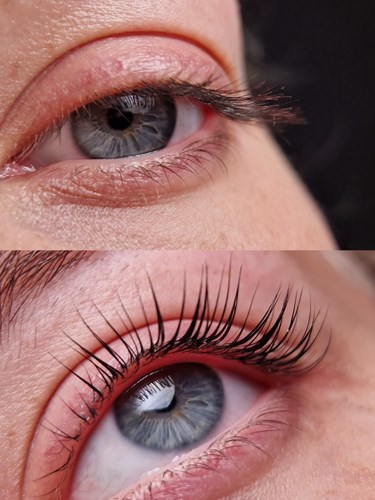
Korean eyelash lamination is a treatment that combines lifting, fixing, and restoring the lashes.
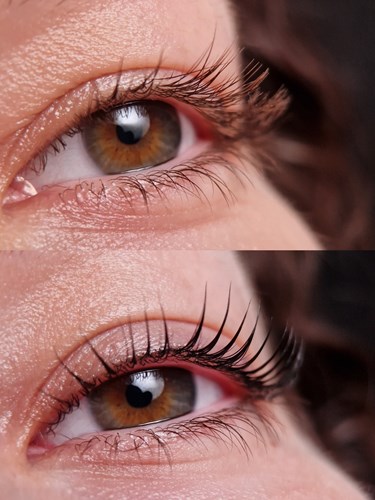
The special feature of the Korean technique is that the focus is not only on the curl but also on nourishing the hair. After the procedure, the lashes look groomed, dense, and shiny. The essence of Korean lamination is that we lift the lashes right from the root, but we can also create a curl if the client wishes.
WHO IS THIS LAMINATION SUITABLE FOR?
1. Deep-set eyes: when the lashes grow downward and “hide” under the eyelid → vertical lifting raises the look and “opens” the eye.
2. Hooded eyelids: the Korean technique lifts the lashes from the root, making them more visible even if the eyelid partially covers the eye.
3. Small, narrow eyes: lifting creates an “open eye” effect, making them look bigger and more expressive.
INGREDIENTS FOR KOREAN EYELASH LAMINATION:
So, what products do we need? We know that Korean eyelash lamination is more about lifting from the root rather than strong curls and waves. How can we know which ingredients are aggressive and which are gentle?
It’s simple: we look at the composition of our products. Which key substances they contain. The main active ingredients in lamination products are THIOGLYCOLATE and CYSTEAMINE.
Thioglycolate is an active chemical component used in eyelash and eyebrow lamination. Its task is to “break” the structure, rebuild the hair (disulfide bonds), so the lash becomes soft and can take on a new shape.
Cysteamine is a substance that changes the shape of the lash but works gently and delicately. It does not break the bonds aggressively but gradually restructures them.
We often hear or read online that products with cysteamine are supposedly closer to natural hair.
THIS IS NOT TRUE. IT IS JUST MARKETING THAT MISLEADS PEOPLE TO SELL THESE PRODUCTS. So I advise you not to fall for it.
POWDER — What is it? Do you need it? How to use it?
This is a powder that is easy to store. When it comes into contact with the solutions during application, it forms a sticky mesh, swells, and creates fixation.
What does the powder do?
— the gel fixes the lashes;
— when drying, it forms an elastic film that holds the shape and color;
— additionally, oils and vitamins nourish the lash and reduce breakage.
DOES POWDER AFFECT THE RESULT?
The powder does not affect the breaking or rebuilding of the bonds in the lash.
The effect depends on how active your Step 1 or Step 2 is.
If the solution has lost its activity (pH drops with each opening), the effect will be weaker — and the powder is not responsible for that.
But too much powder in a product can give the opposite effect:
— excessive thickening reduces penetration of active ingredients;
— too much moisture weakens the curl and shortens durability.
This helps us understand that adding powders to products is possible.
When we add powder, the procedure becomes more delicate.
Powders make the product creamy and thick. It becomes easier for the lash artist to apply and spread.
DO YOU NEED TO PROTECT THE LASHES BEFORE KOREAN LAMINATION?
Speaking from experience — I do not use protection to avoid excess oils that weaken penetration of the powder-infused solution. I simply control lash readiness and apply less solution to the tips (this prevents overprocessing).
CASES WHEN THE PROCESS MAY BE UNCOMFORTABLE:
— Sensitive eyes, eyelid trembling, excessive tearing.
— Allergic reactions, inflammation of the eyes or eyelids, dermatitis around the eyes — the same contraindications as in classic lamination.
— You must be careful when checking lash readiness!
— I hope this information was useful to you!
You can learn even more about the technique of the future, powder analysis, demonstrations, and step-by-step work in my online course KOREAN LIFT, which stays with you forever and includes chat support from me!